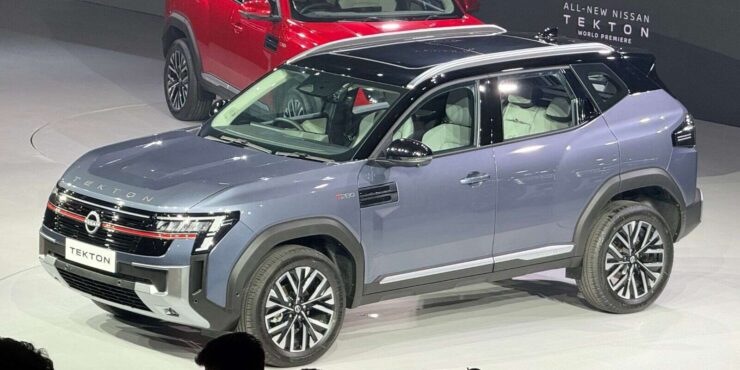
The Nissan Tekton outsold the Renault Duster in August 2026 by recording a total of 491 units as against 406 units for its Renault sibling. The bigger concern is the direction of their monthly numbers. The Duster’s sales peaked at 2,359 units in April before falling every month thereafter and Tekton dropped from 1,670 units in July to 491 units in August. Thus, both SUVs posted their lowest monthly wholesales since launch.
Price and specifications do not explain the decline though. Both start at a competitive Rs. 10.49 lakh, share their 1.0-litre and 1.3-litre turbo petrol engines and come from the Chennai manufacturing facility and are available in an expansive range. The 1.0-litre motor generates 100 hp and 160 Nm while the 1.3-litre turbo unit kicks out 163 hp and 280 Nm.
As for the transmissions, the smaller turbo mill gets a six-speed manual in both SUVs. The larger unit gains either a six-speed manual or a six-speed wet-clutch DCT with e-shifter in the duo. The similarities stretch further as equipment levels are also competitive and almost the same with large touchscreens, digital instrumentation, panoramic sunroofs, wireless charging, six airbags and several camera-based features available across the respective ranges.
Also Read: Nissan Pixo Electric City Car Debuts With 259 Km Range
| Month | Renault Duster | Nissan Tekton |
|---|---|---|
| March 2026 | 1,402 | – |
| April 2026 | 2,359 | – |
| May 2026 | 1,267 | – |
| June 2026 | 1,011 | – |
| July 2026 | 512 | 1,670 |
| August 2026 | 406 | 491 |
| Total Since Launch | 6,957 | 2,161 |
Dealer reach could be one of the bigger obstacles though as both Renault and Nissan operate much smaller retail and service networks than Maruti Suzuki, Hyundai, Tata, Mahindra and Kia. It affects showroom visibility, access to test drives and servicing convenience particularly outside larger cities. For a customer spending Rs. 15 lakh to Rs. 20 lakh, confidence in the dealer and service network can carry almost as much weight as the SUV itself.
The competitive landscape has also changed dramatically since the original Duster arrived in 2012. Hyundai Creta, Kia Seltos, Maruti Suzuki Grand Vitara and Victoris, Toyota Hyryder, Tata Sierra, Honda Elevate, Volkswagen Taigun and Skoda Kushaq now occupy the same space. Powertrain choice is another issue. The Duster and Tekton currently depend mainly on turbo-petrol engines at a time when customers can also choose diesel, CNG, strong-hybrid and electric alternatives.
Also Read: Renault Duster Hybrid To Launch In India On October 17
Perception around after sales support, spare parts availability and resale value could also affect conversion from showroom interest to actual sales. Individual ownership cases differ but established brands often benefit from greater familiarity in these areas. Renault and Nissan also face another task – creating distinct identities for two SUVs that share engines, architecture, dimensions and manufacturing infrastructure. Styling provides some separation and Tekton’s more upright design may have helped it edge ahead in August but the lead of 85 units is too small to establish a clear preference.
Exports show that weak domestic wholesales do not automatically point to a weak product. Nissan exported 1,340 Tektons in August and Renault shipped 1,457 Dusters overseas between April and August. The more immediate problem in India appears to sit around retail conversion, network reach, powertrain spread and brand confidence. Renault and Nissan also plan three-row SUVs which will give both companies another chance to expand their portfolios while the hybridized Duster may salvage things upon arrival next month.
Duster still has the larger cumulative tally at 6,957 units but its slide from 2,359 units in April to 406 units in August is difficult to ignore. Tekton moved ahead last month yet its own 70.6 per cent fall from July shows a similar loss of momentum. The next few months will show whether both SUVs settle into stable volumes or whether the current decline points to a profound retail challenge.