Hyundai is set to launch a new product offensive soon, starting with two new nameplates, both formally confirmed to be introduced by December. The new products are expected to strengthen the company’s position in premium segments.
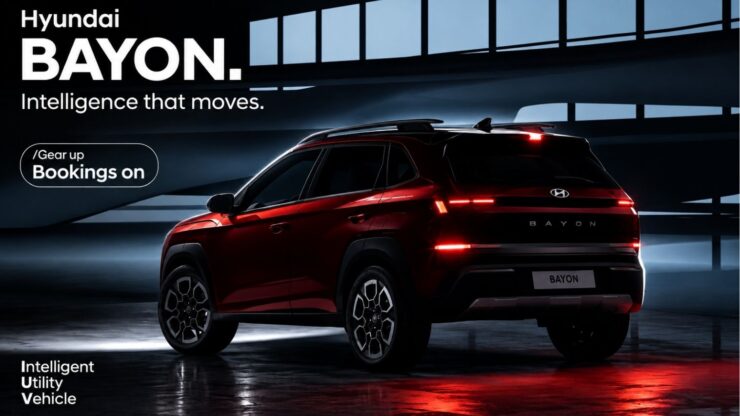
In October 2026, Hyundai will launch its second locally manufactured mid-size SUV following the Creta introduced in 2015. This will be the second generation of the Bayon, which started its life as a Euro-focused model in 2021. Unlike the first-gen model, the second-gen model will be designed keeping in mind the preferences of consumers in India and other emerging countries as well.
Teasers have already revealed that the Hyundai Bayon will shed its crossover character and adopt a more authentic SUV appearance with a boxy and more muscular design. The newly designed model headed to Indian showrooms is likely to be much better in passenger space, cargo volume, and ground clearance compared to the one currently manufactured in Izmit, Turkey.
Also Read: Hyundai’s Big 4 Launches In The Next Few Months
Hyundai has confirmed that the second-gen Bayon measures 4.2 metres in length. The company will likely offer it in 1.5-litre petrol and petrol-CNG variants, with the latter likely featuring an underbody gas tank like Maruti Suzuki’s Victoris. It has confirmed plans to offer a CVT option, which we expect to be limited to the petrol variant.
Sometime in December, Hyundai will launch an all-new electric SUV that could compete with the likes of Tata Nexon.ev, Kia Syros EV, and Mahindra XUV 3XO EV. Codenamed ‘HE1i’, this model will have an even more squarish and rugged exterior, albeit in a much smaller footprint. Hyundai has confirmed it will offer this model with its next-generation cockpit, comprising a 9.9-inch digital instrument cluster and a 12.9-inch touchscreen infotainment system, as well as a raft of Level 2 advanced driver assistance systems.
Also Read: Honda, Renault, Hyundai And Tata To Launch New SUVs Soon
Initially, Hyundai planned to use LFP cells sourced from Exide Energy. However, Exide Energy has postponed production of these cells, while Hyundai has advanced the launch of the HE1i from Q1 2027 to Q4 2026. The South Korean automaker has now decided to source the battery cells from Chinese manufacturer Svolt initially, although it may still stick to LFP chemistry for competitive pricing. We expect it to offer two LFP battery pack options with different sizes, with the larger one delivering a range of around 500 kilometres.