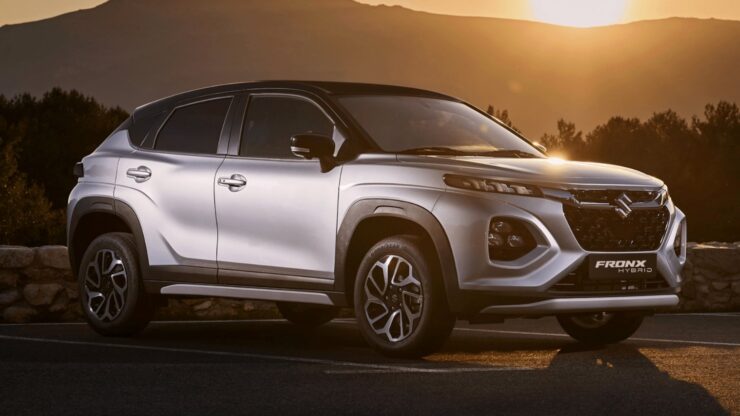
Maruti Fronx Hybrid
Suzuki is preparing a new hybrid strategy for its smaller cars, and it goes considerably beyond the mild-hybrid systems currently used across much of the Maruti Suzuki range. The Japanese automaker has confirmed that it is developing a series-hybrid system for compact cars, which will subsequently evolve into a range-extender hybrid with plug-in capability.
The move is particularly relevant for India, where Maruti Suzuki has a large portfolio of compact cars and SUVs. However, Suzuki has not yet confirmed which specific Indian models will get these powertrains. Suzuki’s first step will be a new series hybrid for compact cars. Unlike a conventional strong hybrid, where the petrol engine and electric motor can both contribute to driving the wheels, Suzuki’s proposed system uses the electric motor to drive the wheels, while the petrol engine works primarily as a generator.
This means the driving characteristics should be closer to an EV, with the motor providing propulsion while the engine generates electricity when required. Suzuki says the system is being developed specifically for compact cars, with cost and packaging being important considerations.
| Powertrain | How It Works | External Charging |
| Conventional petrol | Engine drives wheels | No |
| Strong hybrid | Engine + motor can drive wheels | No |
| Suzuki Series HEV | Motor drives wheels, engine generates electricity | No |
| Suzuki REEV Light | Motor drives wheels, engine acts as generator | Yes |
The company estimates that its compact-car series hybrid could reduce CO₂ emissions by around 29% compared with its 2022 reference point, equivalent to roughly 300kg over 10,000km. Suzuki has not yet announced the battery capacity, motor output or fuel-efficiency figure. Suzuki’s more interesting development is called REEV Light. It takes the same series-hybrid concept and adds an external charging facility.
The idea is to use a right-sized battery rather than a large EV-style pack. For shorter daily journeys, the battery can be charged externally and used for electric driving. Once the battery’s usable charge is depleted, the petrol engine can generate electricity to extend the vehicle’s range. Suzuki says this approach should allow customers to enjoy electric driving without carrying the weight and cost associated with an oversized battery.
The Fronx and Baleno have previously been identified in reports as potential candidates for Suzuki’s compact-car hybrid programme. The 1.2-litre Z12E three-cylinder engine has also been reported as a possible generator for the system. However, Suzuki has not confirmed either model for the REEV Light system, nor has it confirmed that the Z12E engine will be used. These applications therefore remain possibilities rather than announced products.
For India, this technology could give Maruti Suzuki another route between conventional petrol/CNG cars and full EVs. The company already sells Toyota-sourced strong hybrids in the Grand Vitara, Victoris and Invicto, while the e Vitara gives it a full-electric option.