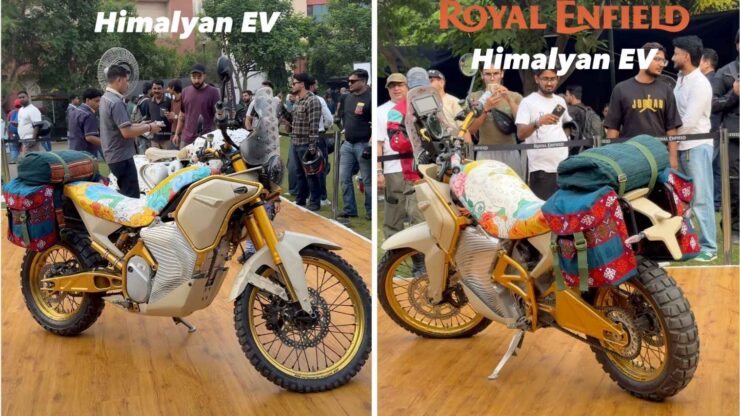
Royal Enfield’s electric Himalayan has once again caught attention, and the motorcycle looks every bit as serious as it did when the HIM-E was first shown. The electric adventure bike has been used extensively for testing, including in the Himalayas, as Royal Enfield works on its future electric technology. But there is an important detail here: this isn’t an upcoming production Himalayan EV yet. Royal Enfield currently describes the motorcycle as a test bed rather than a production model.
The basic adventure-bike silhouette is still unmistakably Himalayan, but the electric powertrain has allowed Royal Enfield to take a very different approach to the design. The motorcycle uses a tall windscreen, round LED headlamp and a single-piece seat, while the conventional fuel-tank area has effectively been transformed into a structural and electrical component housing. The battery and motor form an important part of the chassis architecture. The latest test motorcycles also feature a more conventional-looking aluminium frame compared with the original concept, along with a rally-style tower for the instrument display. The overall design is much closer to a serious off-road motorcycle than a typical electric street bike.
Royal Enfield has not exactly taken the budget route with the Himalayan EV test bed. The test motorcycles have been spotted with fully adjustable USD front forks and an Ohlins rear monoshock, along with spoked wheels and off-road tyres. A large digital display sits high on the handlebar, while the motorcycle also gets aluminium luggage mounts and proper off-road footpegs. The battery pack itself appears to be integrated into the motorcycle’s structure rather than simply being placed inside a conventional frame.
These components suggest that Royal Enfield is using the Himalayan EV to understand how an electric powertrain behaves when subjected to the kind of terrain and conditions expected from an adventure motorcycle.
The Himalayan EV has already been taken to some seriously challenging locations. Royal Enfield has previously shown the motorcycle being tested in the Himalayan region alongside the Himalayan 750.
The testing isn’t just about suspension or off-road ability. Charging is another major challenge. The electric Himalayan has been spotted being charged during testing in Ladakh, including with mobile charging equipment. That is particularly relevant because adventure motorcycles can travel far beyond established charging networks.
Royal Enfield’s own Flying Flea website explicitly states that the Electric Himalayan test bed is intended for rigorous testing and that there are currently no plans to put this motorcycle into production. That doesn’t mean the work is pointless. Quite the opposite. The HIM-E gives Royal Enfield a platform to test batteries, motors, electronics, thermal management, chassis integration and electric power delivery in conditions that are much tougher than a city commute.