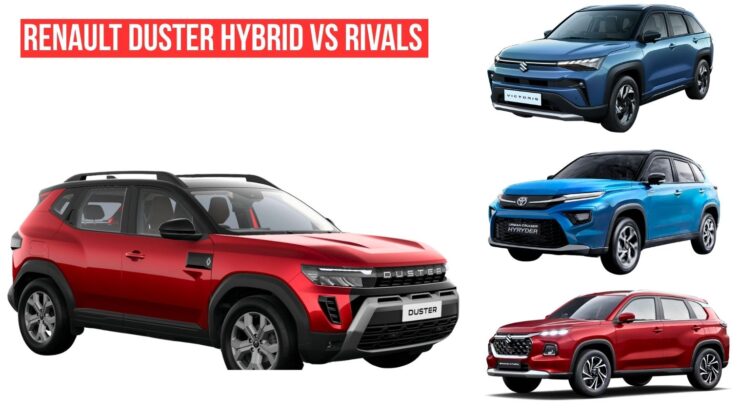
The return of the Renault Duster to India has become more interesting with the arrival of its strong-hybrid version. Priced from Rs 16.99 lakh, the Duster Strong Hybrid E-Tech 160 enters a segment that has largely been dominated by the Maruti Suzuki Grand Vitara and Toyota Urban Cruiser Hyryder. The Maruti Suzuki Victoris has since joined the contest with the same basic hybrid technology.
The Duster takes a different approach. It uses a larger 1.8-litre petrol engine, two electric motors and a bigger battery, producing a claimed 160 PS. Its rivals use a 1.5-litre petrol engine with a single electric motor and deliver around 116 PS.
All prices below are ex-showroom. The Duster prices are introductory, while the other figures reflect the listed strong-hybrid variants and may vary with updates or special editions. The Victoris has the lowest starting price among these four strong-hybrid SUVs, followed by the Grand Vitara.
Also Read: New Tesla Roadster Flying Car Bookings Open In India
| Model | Entry-level Hybrid | Top Hybrid Variant |
|---|---|---|
| Maruti Suzuki Victoris | 16.43 lakh | 19.99 lakh |
| Maruti Suzuki Grand Vitara | 16.68 lakh | 19.77 lakh |
| Renault Duster | 16.99 lakh | 19.49 lakh |
| Toyota Urban Cruiser Hyryder | 17.18 lakh | 20.31 lakh |
The Duster costs more than both at the entry level, but its top variant is cheaper than the corresponding top hybrid versions of the three rivals. That makes the variant comparison particularly important. Buyers should look at the equipment offered at each price point rather than comparing only the starting prices.
| Specification | Renault Duster Hybrid | Grand Vitara / Hyryder / Victoris Hybrid |
|---|---|---|
| Petrol Engine | 1.8-litre, 4-cylinder | 1.5-litre, 3-cylinder |
| Hybrid System | Two electric motors | One electric motor |
| Combined Power | 160 PS | 116 PS |
| Battery Capacity | 1.4 kWh | 0.60 kWh |
| Transmission | Multi-mode automatic | e-CVT |
| Drive Layout | Front-wheel drive | Front-wheel drive |
| Claimed Fuel Efficiency | 29 kmpl | Grand Vitara / Hyryder: 27.97 kmpl; Victoris: 28.65 kmpl |
The Duster’s strong-hybrid system is the most powerful of the four. Its larger engine and dual-motor arrangement also distinguish it mechanically from the Maruti and Toyota SUVs.
Also Read: Hyundai’s Pune Plant Inaugurated; Capable Of Producing Both ICE & Hybrid Cars
The Duster uses an Atkinson-cycle 1.8-litre petrol engine producing 110 hp and 175 Nm, assisted by two electric motors. Its traction motor produces 50 hp and 208 Nm, while a 1.4 kWh battery supplies electrical energy to the system. Renault claims that the SUV can operate in electric mode for up to 80% of city driving conditions. Its claimed 29 kmpl fuel efficiency is the highest among these four models, although the margin over the Victoris is relatively small.
The Grand Vitara, Hyryder and Victoris use a 1.5-litre, three-cylinder Atkinson-cycle petrol engine paired with an electric motor. Their combined output is approximately 116 PS, and all three use an e-CVT transmission. The Duster’s additional power should give it an advantage during acceleration and overtaking. Renault claims a 0-100 kmph time of 9.61 seconds. Real-world fuel efficiency, however, will depend on traffic, driving style and road conditions.
The Duster’s top Emotion variant brings a 10.1-inch touchscreen, a 10.25-inch digital instrument cluster, wireless Android Auto and Apple CarPlay, a panoramic sunroof, ventilated front seats and dual-zone climate control. Its safety equipment includes six airbags and Level 2 ADAS, with features such as adaptive cruise control, autonomous emergency braking and lane-keeping assistance. The Duster also has a larger 1.4 kWh hybrid battery, which is central to its different powertrain approach. Buyers should note that equipment availability varies by variant.
The Grand Vitara offers a 9-inch SmartPlay Pro+ infotainment system, head-up display, 360-degree camera, wireless charging and ventilated front seats, depending on the variant. Higher trims also offer a panoramic sunroof and an eight-way powered driver seat. Six airbags are standard, alongside electronic stability control and other safety systems. The Grand Vitara’s wider range of powertrains, including mild-hybrid petrol, strong hybrid, CNG and selected all-wheel-drive variants, gives buyers more choice than the strong-hybrid comparison alone suggests.
The Hyryder shares its basic hybrid powertrain with the Grand Vitara. Its equipment package includes a touchscreen infotainment system, head-up display, 360-degree camera, ventilated front seats, and a panoramic sunroof on selected variants. It also offers mild-hybrid petrol and CNG options, alongside a strong-hybrid variant. Toyota’s extensive service network and hybrid experience are important considerations for buyers planning long-term ownership.
The Victoris is the most recent addition to this group and places greater emphasis on technology and safety. Its equipment includes a 10.1-inch touchscreen with connected features, an eight-speaker Infinity sound system with Dolby Atmos, a powered tailgate with gesture control and customisable ambient lighting. It also offers Level 2 ADAS, six airbags and a 360-degree camera. Its strong-hybrid system is mechanically related to that of the Grand Vitara and Hyryder, but its newer equipment package gives it a distinct position within the group.
The Renault Duster Hybrid is the most appealing option for buyers who prioritise performance alongside fuel efficiency. Its 160 PS output is substantially higher than the 116 PS offered by the other three, while its claimed 29km/l efficiency is also the best of the group. Its top-spec price is competitive, too.
The Maruti Suzuki Victoris makes a strong case for buyers looking for a feature-rich SUV with a lower entry price for the strong-hybrid powertrain. The Grand Vitara remains a versatile alternative, particularly for those interested in its broader range of powertrain options. The Toyota Urban Cruiser Hyryder benefits from its established hybrid package and Toyota’s ownership network, although its strong-hybrid variants start at a higher price than the other three.
Ultimately, the Duster brings a more powerful and technically different hybrid system to the segment. Whether that translates into a better ownership proposition will depend on real-world fuel efficiency, ride quality, service costs and the final variant a buyer chooses.