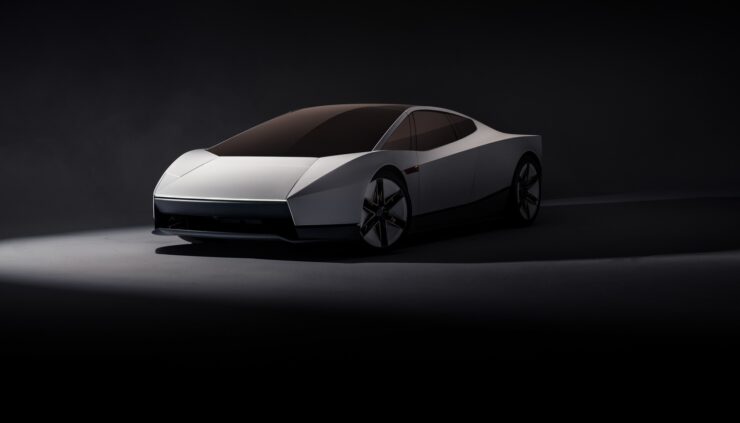
Tesla has unveiled its redesigned second generation Roadster at SpaceX’s McGregor facility in Texas. The electric sports car demonstrated the ability to lift off the ground, rotate in mid air and land safely through a propulsion system developed in collaboration with SpaceX. Furthermore, Tesla showcased the Roadster travelling upside down along a specially constructed ramp and jumping over five stationary vehicles.
The company has announced three configurations named Performance, Thrust and Rocket alongside its production target. The Roadster’s airborne capabilities originate from compressed gas thrusters positioned around the vehicle. Unlike regular rocket engines, these systems expel pressurised gas without combustion to generate additional thrust. Consequently, the vehicle can briefly lift off the ground and adjust its orientation independently of tyre traction.
The McGregor demonstration included a mid air rotation and a controlled landing. However, the prototype demonstrated short airborne maneuvers not sustained aircraft-like flight across extended distances. The American carmaker has also developed a powered suction system that generates downward force through electrically driven fans and an underbody sealing arrangement. The system extracts air beneath the vehicle to create a pressure difference that pushes the car towards the road.
Crucially, this effect does not depend entirely on forward speed unlike conventional aerodynamic wings. Tesla demonstrated the system’s capabilities through an inverted ramp manoeuvre. Additionally, the Roadster incorporates active aerodynamic elements, adjustable ride height and electronically controlled steering.
The Roadster Performance serves as the entry-level configuration and features two seats alongside active aerodynamics and the powered suction system. Tesla claims acceleration from 0 to 96 kmph in under 1.6 seconds. Meanwhile, the two-seat Thrust introduces rear mounted compressed gas thrusters and targets the same sprint in under 0.9 seconds. The flagship Rocket gets additional thrusters for vertical movement and airborne maneuvers. Tesla claims the single-seat configuration can reach 96 kmph in under 0.59 seconds.
The redesigned Roadster features a sharply angled body, concealed headlamps, full-width rear lighting and upward-opening doors. Its aerodynamic package incorporates movable exterior elements and a rear diffuser. On the inside, Tesla has introduced a yoke-style steering control, central touchscreen and additional digital displays positioned near the windscreen. Moreover, the cabin features lightweight materials such as carbon fibre, magnesium and titanium. The Rocket configuration replaces the two-seat arrangement with a single driver’s seat.
Tesla has quoted a top speed of over 370 kmph and a driving range of 480 km. These figures differ substantially from the original Roadster concept unveiled in November 2017 which advertised a 1,000 km range and a proposed 200 kWh battery. A dual-motor RWD configuration and Tesla’s cylindrical 4680 battery cells are likely too. The brand has reopened Roadster reservations in selected markets.
The Performance configuration carries a reported US reservation requirement of $50,000 while the Thrust requires $250,000. The Rocket is restricted to invitation-only customers and has not received approval for public road operation. Furthermore, availability of its airborne capabilities will depend on regional regulations. Production is scheduled to commence in 2028, more than a decade after the original Roadster’s presentation.