Representational
Suzuki is developing two new 1.2-litre powertrains as part of its next generation engine lineup. One is a direct injection turbocharged petrol unit rated at around 125 hp and 230 Nm and the other is a new hybrid unit capable of delivering up to about 174 hp in its higher specification. The projects may enable Suzuki two distinct routes for future small and midsize models.
The turbocharged engine uses direct injection and forced induction to extract substantially more output from a compact displacement. Its reported 125 hp and 230 Nm figures place it well above Suzuki’s current naturally aspirated small capacity petrol engines. The torque output also puts it close to several larger turbo petrol units already sold in slightly more premium vehicles.
The multi-fuel capability is an important part of the new turbo programme. The 1.2-litre engine is reported to support petrol, E100 ethanol, CNG and compressed biogas. The Japanese brand has already placed bioethanol and CBG among the fuels it wants to develop alongside conventional petrol for India and global markets.
Also Read: Maruti Suzuki Targets Nearly 10 Lakh Green Vehicle Sales This FY
India fits closely with that fuel programme because Maruti Suzuki already sells a large range of factory-fitted CNG vehicles. Suzuki has also invested in compressed biogas production in the country creating a direct link between its CNG vehicle base and future CBG utilisation. Ethanol support adds another fuel option as India expands its ethanol-blending project.
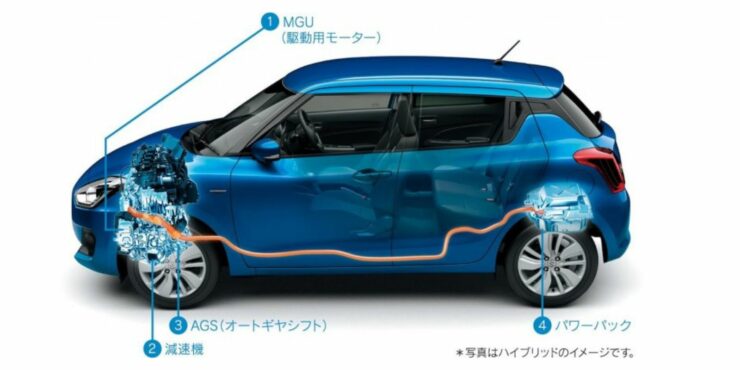
The second 1.2-litre unit sits at the centre of a new hybrid system with reported output of up to 174 hp. Suzuki’s electrification work includes Series Hybrid technology and Super Ene Charge which centres on a 48V electrical architecture. The latter is designed to provide better electric assistance without adding the weight of a large traction battery.
Also Read: These Maruti Suzuki Cars Are Coming To India By 2027
On the other hand, Series Hybrid technology takes a different technical route. The petrol engine can work primarily as an electricity generator and the electric motor can handle propulsion for much of the drive cycle. The layout suits Suzuki’s target of lightweight vehicles because it can deliver strong low speed response and lower fuel consumption. The duo of 1.2-litre engines confirm a substantial jump from Suzuki’s current small engine formula.
The company’s presentation also shows a route from Series HEV to REEV Light and PHEV through external charging capability and a correct sized battery. Suzuki says its compact Series HEV targets about 29 per cent lower CO2 emissions versus 2022 – equivalent to around 300 kg less CO2 per 10,000 km. Suzuki also listed next generation e-Axles rated at 70 kW for Mini/A-segment vehicles and 130 kW for B-, C- and D-segment models. A separate electric four-wheel-drive system is planned with outputs of 10 kW and 30 kW respectively.