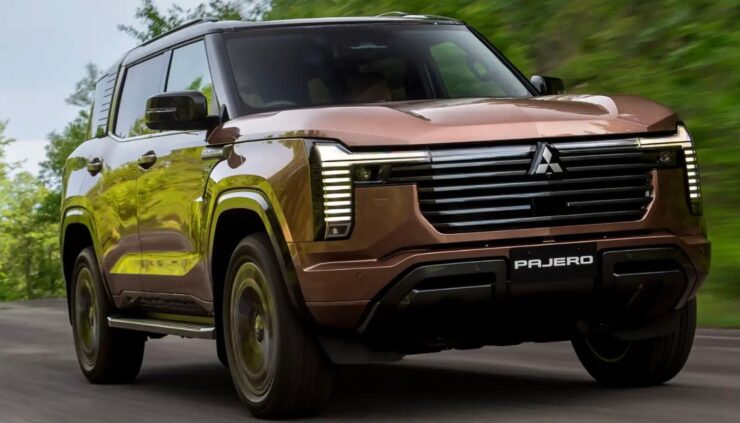
The Mitsubishi Pajero has returned for a fifth generation after the nameplate disappeared from the global markets in 2021. The new SUV goes back to its off-road roots as it boasts a ladder-frame chassis derived from the Triton pickup along with three rows of seats, a brand new cabin and a 2.4-litre turbocharged diesel engine.
The Pajero name has a long history in Mitsubishi’s SUV lineup. The first generation arrived in 1981 and established the model as an out-and-out off-roader while later generations built a reputation through international rally competition and a vital presence in markets such as Japan, Australia and parts of Asia. However, the third and fourth generations moved away from the traditional layout to monocoque construction.
The fourth-gen remained on sale for 15 years before production ended in 2021. The change comes as Mitsubishi needs a large off-road SUV above the Outlander while the Pajero Sport has served as its Triton-based alternative in several markets. The new Pajero effectively brings those two strands together. It retains the Pajero name and styling cues from older models but its mechanical bits are based on the latest Triton.
The ladder frame supports a solid rear axle, four-wheel coil springs and disc brakes while the model gets its own suspension calibration and cabin rather than simply becoming an SUV version of the pickup. The exterior takes a boxy and upright shape that recalls the classic Pajeros. The tall panels sits on a long wheelbase while short overhangs, a near-vertical windscreen and a flat roof give it traditional off-roader proportions.
The front gets an upright grille, stacked LED daytime running lights, round auxiliary lamps and a squared lower bumper. At the rear, PAJERO lettering stretches across the light bar while vertical tail-light graphics, side steps, black lower cladding and twin exhaust-like bumper inserts enable a rugged appeal. The cabin gets a more modern treatment than the exterior might suggest.
The top-spec variants offer two 14.3-inch screens, leather upholstery, a panoramic sunroof and triple zone automatic climate control. The dashboard combines tan and black trim while physical controls remain below the main touchscreen. An off-road display shows altitude, roll angle and pitch angle, and a rotary terrain selector sits beside the gear lever.
Power comes from a new version of the Triton’s 2.4-litre four-cylinder turbocharged diesel engine. The Pajero gets a single turbocharger rather than the Triton’s twin-turbo setup while output stands at 201 hp and 480 Nm. An updated eight-speed automatic sends power to all four wheels and the four-wheel-drive system supports regular tarmac as well as off-road driving.
Mitsubishi also has hybrid and plug-in hybrid versions under consideration but a larger engine such as a V6 is not planned. The new Pajero is expected to come in GLX, GLS, Exceed, and GSR grades placing it against the Ford Everest and Toyota Prado. India, however, appears highly unlikely to get the new SUV despite Mitsubishi and Nissan being partners in the global Renault–Nissan–Mitsubishi Alliance where Nissan holds a 34 per cent controlling stake in Mitsubishi Motors.