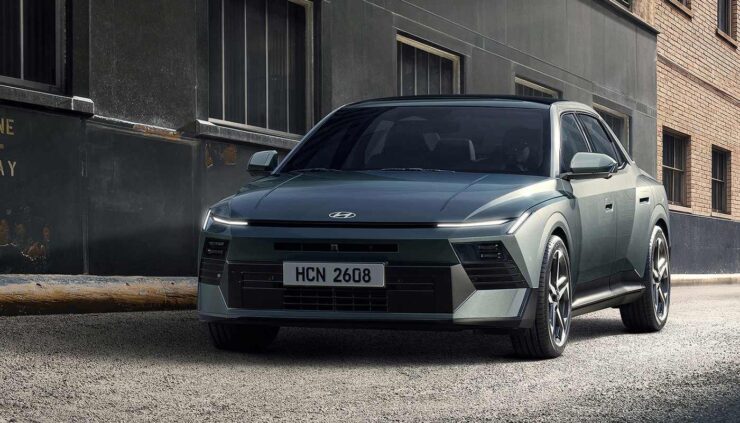
The eighth generation Hyundai Elantra made its public debut at the ongoing Los Angeles Auto Show – three months after its introduction as the Avante in Korea. North American sales are scheduled for early 2027. The redesign is substantial: Hyundai has stretched the wheelbase, reshaped the body and introduced a different infotainment architecture, yet the car retains its compact-sedan identity.
Inside, Hyundai has given the Elantra a 12.9-inch Pleos Connect touchscreen built on Android Automotive OS. The system supports over-the-air upgrades and third-party applications via the Pleos App Market, but its Gleo AI assistant can also interpret more complex conversational requests. Drivers can ask for destinations based on journey times and nearby parking, and the assistant takes those conditions into account.
The 1.6 L hybrid delivers a combined 157 PS via a six-speed dual-clutch transmission. Alongside it, the new 2.0 L petrol develops 149 PS, or 26 PS more than the previous 1.6 L engine, and relies on an IVT automatic. Hyundai quotes 35 mpg for the petrol version.
| Powertrain | Engine | Output | Transmission |
|---|---|---|---|
| Hybrid | 1.6 L petrol-electric | 157 PS combined | 6-speed DCT |
| Petrol | 2.0 L petrol | 149 PS | IVT |
The Hybrid Hierarchical Predictive Control System forecasts road conditions ahead and adjusts the balance between engine power and electrical assistance. Smart Regeneration System 3.0 separately recovers kinetic energy under deceleration, and Stay Mode operates climate control, audio and lights when the vehicle is parked. Consequently, those amenities do not require the petrol engine to idle throughout a stop.
Hyundai has also revised the Elantra dimensions considerably. The sedan is now 85 mm longer and 30 mm wider, and its wheelbase has increased by 30 mm. Rear legroom measures 993 mm, a 29 mm improvement, and rear headroom rises 18 mm to 958 mm. Under the Art of Steel design theme, pronounced fenders and a long bonnet establish the proportions. Horizontal H-Edge daytime lamps contrast against vertical rear lights, and flush lift-up door handles accentuate the sides.
The additional cabin space complements the furniture-inspired Curve of Upholstery design, which softens the otherwise angular character of the exterior. Importantly, Hyundai has retained physical switches for essential functions, and a narrow information screen sits in the natural driver sightline. Other equipment comprises two 15 W Qi 2.0 wireless charging pads, 100 W USB ports, Bang & Olufsen audio and Hyundai Digital Key 2. Six interior colour themes range from Black/Black to Burgundy/Rose Ivory and Chalk Beige.
The safety provisions combine structural protection and electronic intervention. Ultra-high-strength steel reinforces critical body sections, and the available SmartSense suite has Forward Collision-Avoidance Assist 2, Blind-Spot Collision-Avoidance Assist and Safe Exit Warning. Lane Following Assist 2 and Memory Reversing Assist support lane control and low-speed manoeuvres respectively. An In-Cabin Monitoring Unit checks driver alertness and wheel contact, and camera-based occupant detection works alongside seat belt alerts and Rear Occupant Alert.