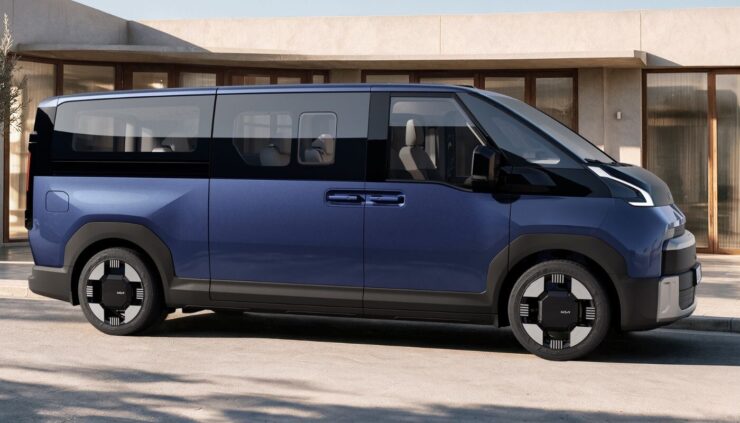
Kia has revealed the PV7 with more than 460 km of targeted WLTP range and an 800V electrical architecture capable of 350 kW DC fast charging. The second model in Kia’s dedicated Platform Beyond Vehicle lineup after the PV5 will reach Korea and Europe in the second half of 2027. Two battery capacities will be available and Kia plans to eventually expand the PV7 family to 23 variants across passenger, cargo and specialist applications.
The Passenger version can seat up to nine occupants in global markets and up to 11 in Korea. Kia will offer a seven-seat configuration with Long-Rail Easy Remove Seats and the nine-seat model can be specified with or without a fourth row. Rear climate control, storage areas and 100W USB-C charging points are also listed with the model aimed at shuttle, tourism, rental, crew transport and family applications.
Cargo capacity reaches 6.1 cubic metres in the Long derivative and 8.0 cubic metres in the High Roof. Maximum payload stands at 1,165 kg for the Long and 1,200 kg for the Compact and the Long can accommodate three Euro pallets through a loading height of 550 mm. Kia will offer twin-swing rear doors or a lift-up tailgate, based on specification alongside independent cargo-door locking and remote door status monitoring.
Two NCM battery packs measuring 71.5 kWh and 96.2 kWh will power the PV7 range. As per market and specification, the electric drivetrain produces up to 268 hp and 420 Nm with front-wheel drive standard at launch and all-wheel drive planned later. A 10 to 80 per cent charge should take somewhere in the mid-20-minute region on a 350 kW DC charger. Kia also provides a front AC/DC charging port and an optional rear-side AC connection.
On the inside, the PV7 features 12.9-inch and 14.6-inch displays linked to the Pleos Connect system based on Android Automotive OS. Connected navigation, an app marketplace, over-the-air software updates and the Gleo AI voice assistant feature in the technology package. The Cargo cabin adopts a Mobile Workspace layout with open storage and three-seat versions can convert the centre seatback into a tray. Passenger versions add more enclosed storage, optional ambient lighting and a centre console that can double as a table.
The safety equipment list comprises seven airbags, Forward Collision-Avoidance Assist, Lane Keeping Assist 2.0, Navigation-based Smart Cruise Control and Highway Driving Assist 2.0. Remote Smart Parking Assist, parking sensors, Rear View Monitor, Surround View Monitor and Built-in Cam 3.0 are also listed based on market and derivative. The exterior gains a cab-forward silhouette, flat roof, hidden headlamps, black bonnet treatment and replaceable bumper and cladding sections intended to simplify repairs.
Kia will eventually offer Cargo Compact, Long and High Roof versions, Passenger Compact and Long models, a Chassis Cab and multiple conversion derivatives. Production support will come from Kia’s Hwaseong EVO West PBV Plant and PBV Conversion Center with regional conversion partners supplementing specialist builds. The PV7 will first go on sale in Korea and Europe during the second half of 2027 with other markets and additional derivatives scheduled later.